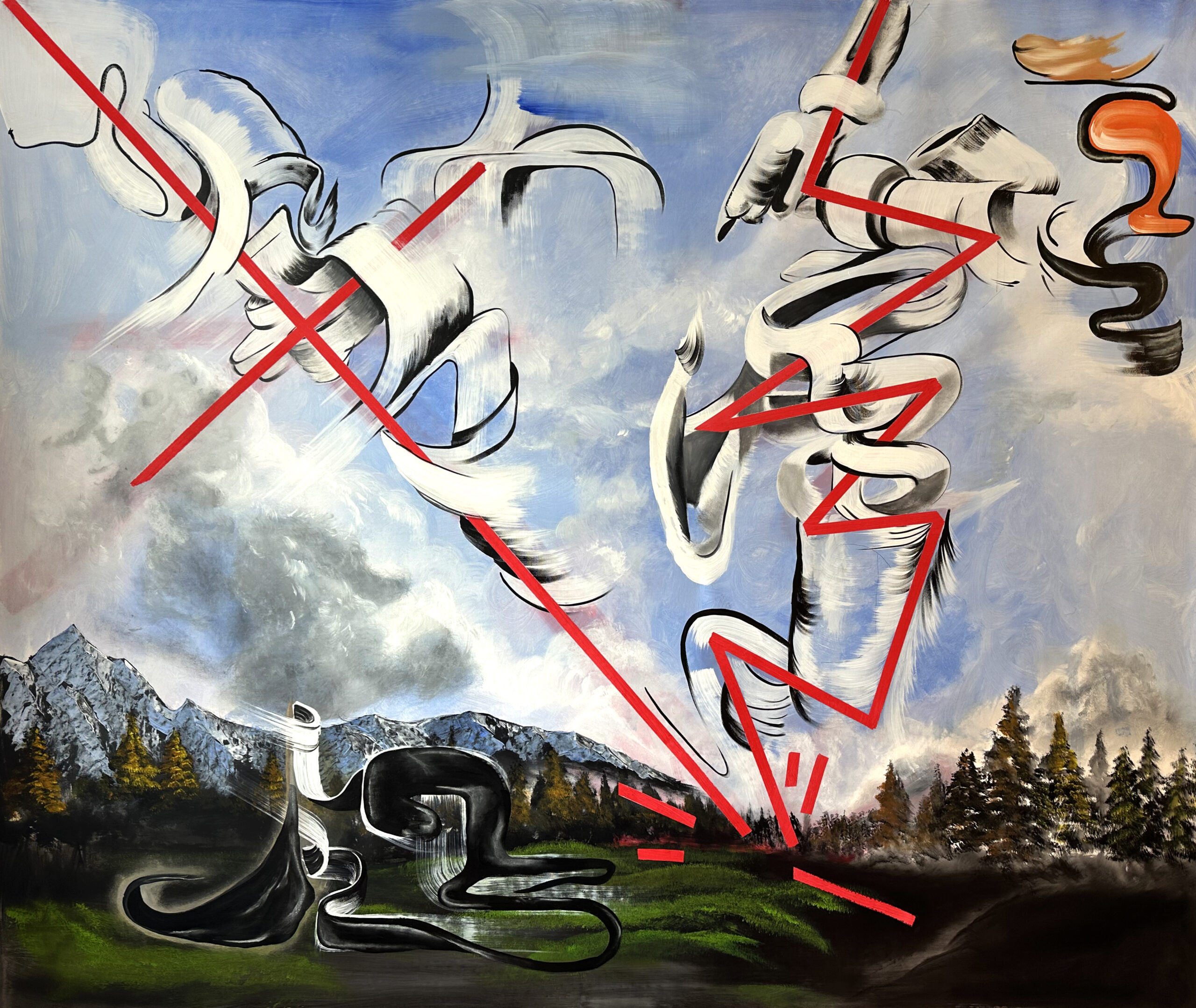
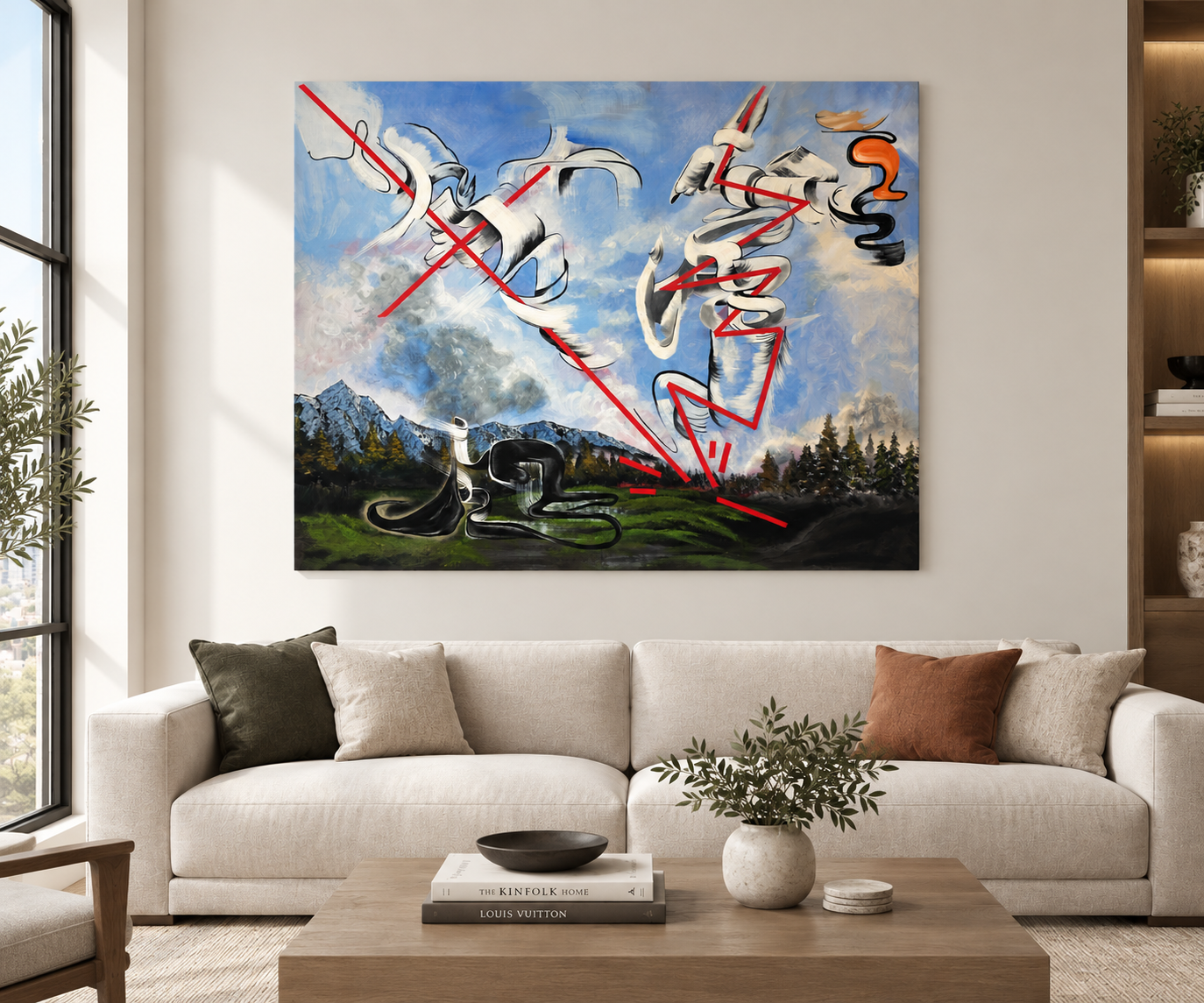
“Postcards of scenes awaiting the light. Cracks through which a miracle might break through the surface. Suspended landscapes. Portals. Shifting mirrors among shadows, branches, brushstrokes…
Something is about to happen. An expectation. A flower finally opens for the first and last time.
The instant.
One of the central themes is the search for, or anticipation of, the exact moment when something is perceptually apprehended. A perceptual threshold. Creation. Existence.
Light travels constantly, without aging, eternally, until it is halted by a gaze that absorbs it, gives it substance, gives it time, gives it form. Faith. Science fiction.”
Excerpt from a text by Dani Umpi.
The complete text can be found below:
A Request for Clarity
On the series Light Does Not Age
by Juan Pablo Inzirillo, 2026
By Dani Umpi
When I first saw one of Juan Pablo Inzirillo’s paintings, I immediately thought of the cross of Mamá Antula.
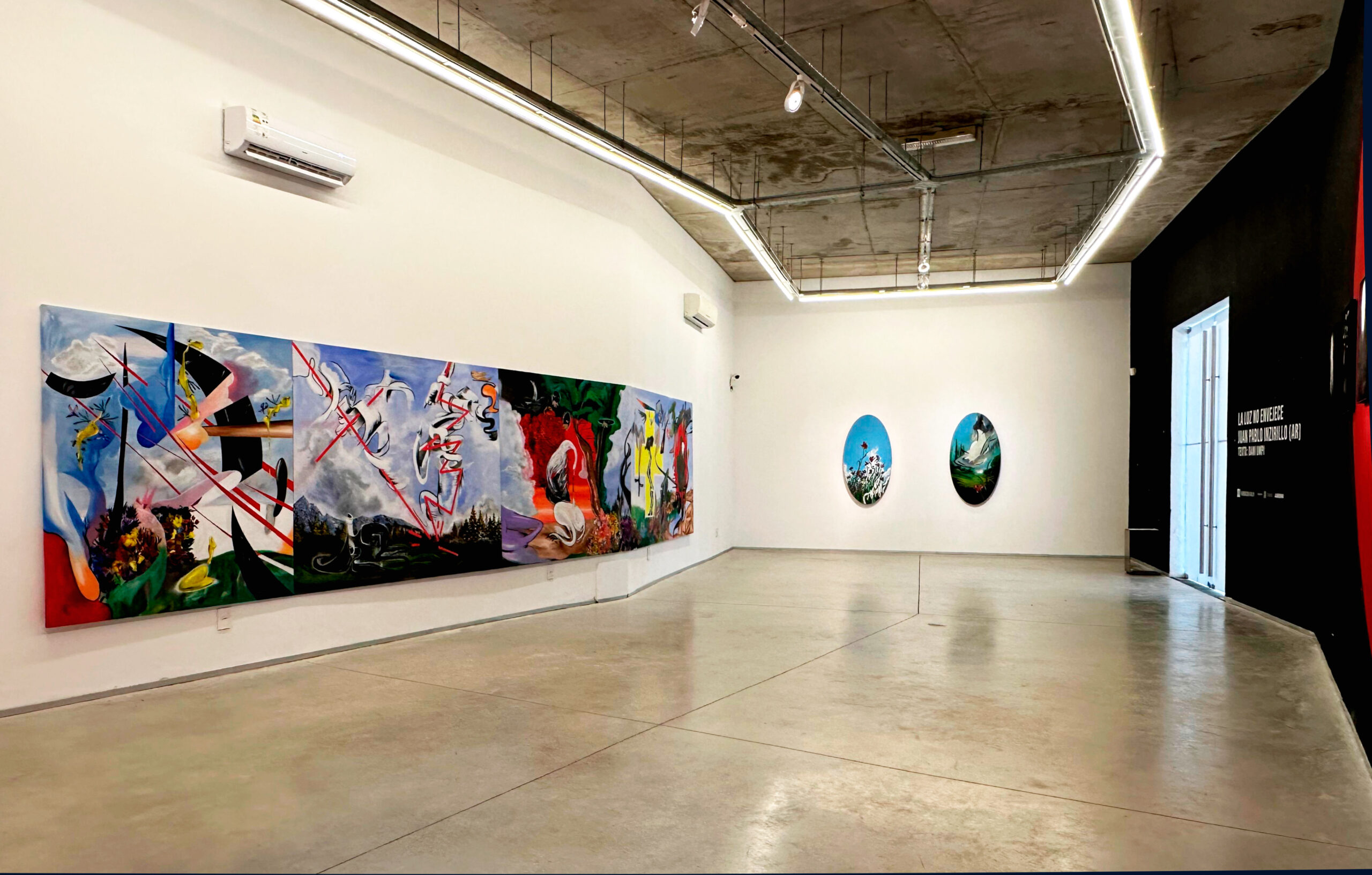
Two beams of light cut through the painting. One follows a zigzagging path. The other takes the form of a missionary cross. In my mind, of course, my Ignatian instinct was immediately activated. A way of reading the image. A ray of light.
Although this new series of large-format works has no explicit spiritual reference, I could not stop indulging in the discovery of symbolic connections between its landscapes and scenes in motion.
Postcards of scenes awaiting the light. Cracks through which a miracle might break through the surface. Suspended landscapes. Portals. Shifting mirrors among shadows, branches, brushstrokes…
Something is about to happen. An expectation. A flower finally opens for the first and last time.
The instant.
One of the central themes is the search for, or anticipation of, the exact moment when something is perceptually apprehended. A perceptual threshold. Creation. Existence.
Light travels constantly, without aging, eternally, until it is halted by a gaze that absorbs it, gives it substance, gives it time, gives it form. Faith. Science fiction.
The gaze is never innocent. Eyes hide in cracks and behind veils. They look out from behind the image. Something. Someone. The painting returns the unsettling gaze. A surveillance system. A reciprocal game of watching and being watched.
At any moment, a light will pierce the veil of reality. Plato.
Light within the tree. Nature concealing the revelation. Geometric forms of nature.
His works combine technical approaches that coexist without apparent conflict. Hyperrealist, decorative, and abstract strategies, as well as a kind of “methodical painting,” associated with home tutorials or domestic painting techniques. The liturgical and the pop, the domestic and the metaphysical, constantly intermingle.
At times, his work moves away from classical Surrealism and enters a territory closer to Symbolism. Inner states shaped by invisible forces.
I recall that Salvador Dalí himself received a Jesuit education, and one could easily speculate that his foundational imagery, with its visions of Baroque theatricality and elusive symbolism, retains traces of that contemplative, mystical visual education.
Ignatian spiritual exercises, as techniques for inner visualization, teach precisely how to use the imagination as an instrument of knowledge. To visualize scenes.
The paintings function as mental stages for metaphysical theaters. Landscapes of introspection. Contemplative devices in which something is about to manifest itself. A constant feeling of waiting. A state preceding an appearance. Of what?
The so-called “composition of place” proposes mentally reconstructing a scene with extreme precision before beginning meditation. Meditation then becomes an almost theatrical experience. A scene in which to observe attentively the inner movements of the artist.
How can we recognize the instant when something truly passes through us and transforms us?
The subject transforms by passing through inner trials, intense images, and ambiguous territories of desire.
A swan engages in dialogue with its own reflection. Two swans. One and the same. Eyes hidden behind slashes. A continuous superimposition of layers in which the image observes itself. Shadows watching from another plane.
The shadow appears not merely as the dark side of the self. It is a space of transformation, an almost Gnostic imaginary. The veil of reality. The visible world concealing another dimension.
The shadow mutates, becoming elastic, turning into mist. It is in transit, on a journey. And so I think of that cross as a cross being carried. A cross in motion, along a path.
Movement.
There is no such thing as motionless contemplation.
An authentic instant of revelation. When will it arrive?
 Free shipping from Latin America to the contiguous United States

 Uruguay