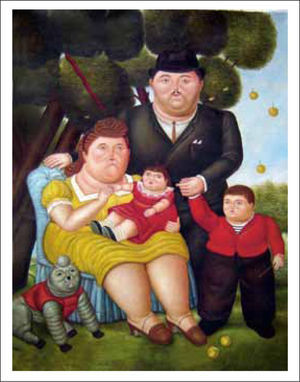
La familia
Fernando Botero’s La familia (1973) is the perfect entry point into Boterismo, the artist’s signature style of inflated, almost balloon‐like figures. On a tranquil domestic terrace, each character’s rounded torso and exaggerated limbs convey a sense of weightlessness and gentle humor. Yet beneath the surface whimsy lies a subtle commentary on power dynamics within family structures. Collectors are drawn to this work’s flawless surface, its jewel-like color harmonies, and the way Botero transforms everyday scenes into meditations on form and volume.
Las hamacas
Alejandro Obregón’s Las hamacas (1953) plunges viewers into a raw, expressionist vision of tropical life. Thick impastos of emerald and ochre swirl across the canvas in rhythmic strokes that evoke swaying hammocks and restless breezes. Sharp diagonals and off-balance compositions hint at political unrest, while Obregón’s palette—both vibrant and brooding—underscores his restless energy. For enthusiasts, this painting crystallizes mid-century Colombia’s turn toward abstraction infused with social urgency.
Desnudo
Luis Caballero’s Desnudo (1957) stands as a landmark of figurative expressionism in Colombia. Here, the human body is neither idealized nor moralized; instead, Caballero’s brush carves into deep reds and blacks, revealing the erotic and the anguished in equal measure. The artist’s use of smeared pigments and rugged textures brings flesh to life in its most vulnerable state. Collectors seeking emotionally charged works prize Desnudo for its unflinching honesty and the way it blurs boundaries between beauty and violence.
Autorretrato
Débora Arango’s Autorretrato (1981) channels a fierce, feminist expressionism that challenged conservative norms throughout her career. In stark black lines and flat expanses of crimson and jade, Arango confronts the viewer with her own gaze—defiant, introspective, unbowed. The painting’s raw immediacy and bold color choices speak to her lifelong commitment to social critique, from gender inequities to political repression. Art enthusiasts today value this work as both a personal manifesto and a milestone in Latin American modern art.
La rotunda
Enrique Grau’s La rotunda (1965) reveals a lyrical fusion of figuration and abstraction. Three stylized female profiles overlap in a muted chorus of sepia and ochre, their serene features rendered through smooth, planar brushwork. Grau omits narrative detail, inviting contemplation of form, rhythm, and negative space. This refined balance between stillness and suggestion attracts collectors who appreciate painting as a quiet, almost sculptural exploration of the human figure.
Retrato de Gloria Zea
David Manzur’s Retrato de Gloria Zea (1975) exemplifies Colombian academic realism at its peak. Manzur employs chiaroscuro to dramatic effect, carving his sitter’s face from shadow into light with meticulous brushstrokes. Every eyelash, every glint in her eye, communicates psychological nuance. For art lovers, this portrait is more than likeness—it’s proof of Manzur’s mastery over classical technique, applied to modern sensibilities, making it a standout in any collection devoted to realism.
Sin título
Omar Rayo’s untitled geometric abstraction, often referred to simply as Sin título, showcases his rigorously precise optical vocabulary. Lines and chevrons in black, white, and primary colors interlock in mathematically exact patterns that seem to vibrate before the eye. Rayo’s work bridges painting and graphic design, reflecting a lifelong fascination with movement and perception. Collectors drawn to Op Art and constructivist legacies prize these canvases for their intellectual clarity and subtle visual dynamism.
Collecting famous Colombian paintings means tracing a thread from Botero’s buoyant volumes through the passionate expressiveness of Arango and Caballero, and onward to the lyrical poise of Grau and the clinical precision of Rayo. Each of these works illustrates a distinct style—Boterismo, expressionism, academic realism, geometric abstraction—and together they map the rich, multifaceted evolution of Colombian art. For enthusiasts, owning any of these masterpieces offers both a deep emotional resonance and a window into the nation’s creative spirit.
Related Articles