Brazilian painting weaves together social commitment, modernist experimentation, and vibrant popular culture—qualities that have propelled its masterpieces onto the international stage and into discerning collections. Below are ten landmark works whose styles define key moments in Brazil’s artistic evolution, each offering collectors a distinctive combination of aesthetic innovation and market allure.
Guerra e Paz (1952–1956) by Cândido Portinari
Portinari’s monumental panels for the United Nations in New York unify social realism and modernist form. Executed in tempera over a grand scale, Guerra e Paz balances dynamic compositions of workers and symbols of progress against stylized backgrounds. The rhythmic grouping of figures and the artist’s earthy palette underscore themes of conflict and reconciliation, making original studies and sketches for this project highly coveted by collectors seeking historically significant works.
Abaporu (1928) by Tarsila do Amaral
As the emblem of Brazilian modernism, Abaporu champions the Anthropophagic movement’s call to “devour” European influences and create a native cultural language. Amaral’s oversized foot and hand, rendered in flat, jewel-toned fields, evoke both vegetal growth and human strength. The painting’s crisp lines and simplified forms exemplify her fusion of Cubist structure with folk motifs, and its rarity in private hands ensures that any authentic Amaral canvas remains a centerpiece acquisition.
A Boba (1917) by Anita Malfatti
Malfatti’s groundbreaking exhibition introduced sharp color contrasts and emotive distortion to São Paulo’s conservative art world. In A Boba, her angular figure sits in a void of dissonant blues and greens, the exaggerated perspective and raw brushwork reflecting Expressionism’s psychological intensity. Early buyers prize Malfatti’s pioneering works for their pivotal role in Brazil’s avant-garde, and her small-scale paintings surface only sporadically, often exceeding auction estimates.
Operários (1933) by Tarsila do Amaral
Returning to social themes, Amaral’s Operários depicts a wall of anonymous factory workers that merges portraiture with political allegory. The tightly packed faces, each subtly individualized through color accents and simplified contours, demonstrate her mastery of pattern and repetition. This piece’s direct engagement with industrial modernity, coupled with Amaral’s crisp, linear style, makes Operários a key holding for those focused on art that bridges modernist design and social commentary.
Café (1935) by Cândido Portinari
Portinari’s Café translates Brazil’s coffee economy into monumental, almost sculptural figures harvesting beans in sun-bleached fields. Broad, sculpted forms and a muted, dusty palette convey both physical labor and national identity. The painting’s tactile brushwork and rhythmic composition resonate with collectors looking for canvases that combine formal rigor with deep cultural resonance, and its preparatory cartoons are among the most sought-after items in Latin American art auctions.
Samba (1925) by Emiliano Di Cavalcanti
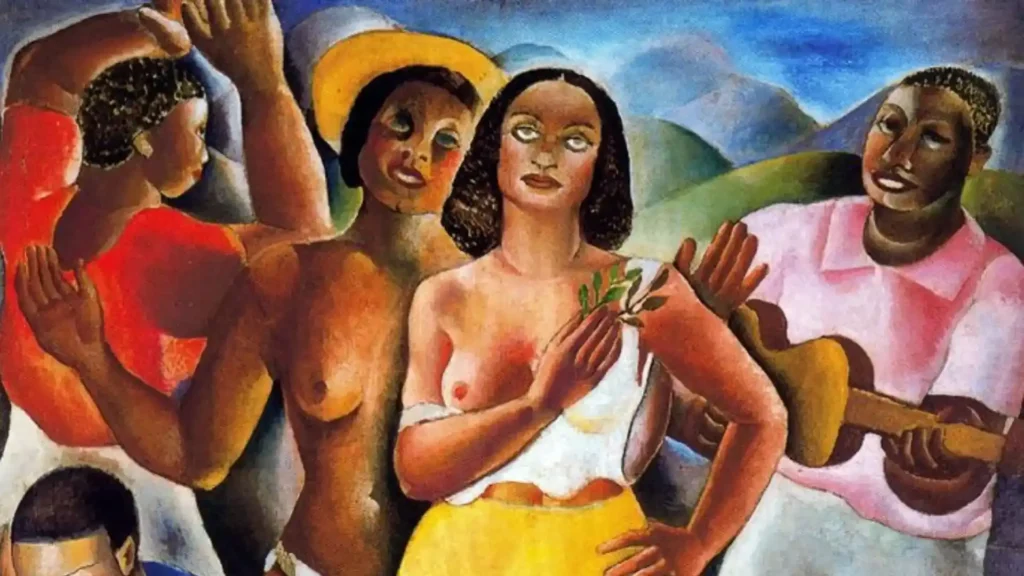
Di Cavalcanti’s early modernist vision bursts in Samba, where dancers and flutists swirl in sinuous lines against a flat backdrop. His palette of warm ochres, greens, and reds, applied in fluid strokes, captures the music’s movement and the city’s nocturnal energy. The painting’s decorative vitality and clear modernist vocabulary appeal to collectors who value works that both celebrate and stylize Brazil’s popular traditions.
Bandeirinhas (c. 1948) by Alfredo Volpi
Volpi’s series of small flags—bandeirinhas—transforms folk iconography into a refined language of color and geometry. Each pennant floats against monochrome fields, its precise edges and layered pigments reflecting Constructivist influences. The subtle shifts in hue and the artist’s signature scalloped brushwork create optical depth, making these modest-sized canvases prized for their formal elegance and unexpected market momentum.
Navio de Emigrantes (1939) by Lasar Segall
Segall’s émigré background infuses Navio de Emigrantes with an Expressionist urgency. Dark, angular forms of human figures crowd the deck, their elongated limbs and stark outlines intensified by a moody, near-monochrome palette. The painting’s emotive tension and personal narrative resonate with collectors interested in works that speak to migration and identity, while its scarcity at auction adds to its exclusivity.
Autorretrato (1951) by Iberê Camargo
Camargo’s self-portrait offers a master class in gestural abstraction and emotional depth. Vigorous black strokes burst from a light ground, shaping a face that seems both present and eroded. His layered application of pigment and calligraphic lines reveal an existential inquiry rendered through paint. Original Camargo canvases from this period command premium prices, prized for their raw intensity and the artist’s posthumous rise in critical esteem.
Meu Limão (1998) by Beatriz Milhazes
Milhazes’s contemporary abstractions synthesize Baroque exuberance, geometric order, and Brazilian ornament. In Meu Limão, exuberant floral motifs and arabesques overlap in translucent layers of acrylic and Brazilian resin paint. The work’s bright color harmonies and symmetrical composition appeal to modern interiors and collectors seeking a living artist with a robust auction record. Milhazes’s canvases blend decorative allure with rigorous pattern, ensuring both visual impact and investment potential.
For art collectors, Brazilian paintings offer a journey from mural-scale social statements to intimate explorations of color and form. Understanding each work’s stylistic language—whether it’s Portinari’s humanist realism, Amaral’s tropical modernism, or Milhazes’s ornamental abstractions—allows collectors to curate a balanced portfolio that reflects Brazil’s rich artistic legacy and delivers proven market strength.
Related Articles