Xul Solar’s visionary charts of the cosmos, such as Untitled Astral Map, live at the intersection of mysticism and abstraction. Rendered in watercolor and tempera on paper, these works present concentric halos of color punctuated by geometrical glyphs. Solar’s flattened planes and spectral palette summon a dream logic that transcends earthly concerns. As the progenitor of an Argentinian surrealist vernacular, these maps remain coveted by collectors drawn to art that bridges art history and esoteric philosophy.
In Contrapicado (1925), Emilio Pettoruti distilled Cubist fragmentation into a uniquely Porteño shorthand. His angular forms—tilted rooftops, skewed figures—cascade across the canvas in cool blues and grays, then puncture into warm ochres. The dynamic skewness of his perspective captures both the modern metropolis and the tension of early 20th-century Europe. To collectors, Pettoruti’s Cubist experiments represent a critical moment when Buenos Aires aligned itself with Paris, and authentic canvases remain elusive on the secondary market.
Florencio Molina Campos’s folkloric scenes, especially La Cosecha, revel in the costumbrista tradition with a playful twist. Gauchos harvest mate leaves beneath an expansive sky, rendered in broad, fluent brushstrokes and vivid primary hues. His stylized figures—round faces, exaggerated hats—blend caricature with affectionate homage to rural life. Campos’s canvases, once circulated as lithographs and calendars, now command collector attention for their populist appeal and painterly craftsmanship.
Raquel Forner’s cosmic epic Idolatría del Dorado (1958) soars beyond terrestrial bounds in an Expressionist outpouring. Thick impasto in crimson and obsidian swirls around a glowing golden orb, suggesting both mythic sun worship and nuclear-age dread. Forner’s gestural strokes and stark contrasts convey palpable tension between creation and annihilation. Collectors prize this painting as a landmark of postwar Latin American abstraction, emblematic of an artist who balanced activism and allegory at a moment of global upheaval.
Alfredo Hlito’s 1958 Abstracción Dinámica exemplifies Argentina’s embrace of geometric abstraction after World War II. Meticulously measured bands of ultramarine, cadmium red, and ivory intersect in diagonal rhythms that compel the eye to dance across the plane. Hlito’s commitment to optical harmony and spatial ambiguity ties his work to Constructive Universalism, yet his subtle textural variation turns each segment into its own microcosm. These rigorously composed canvases have gained traction among collectors who favor minimalist expression with intellectual rigor.
Julio Le Parc’s 1961 painting Relieve Constante pulses with the kinetic energy that would define his later sculptural works. Across a uniform white ground, slender black lines undulate in syncopated waves that appear to warp as the viewer shifts position. Though static on the wall, the painting conjures perpetual motion through optical illusion alone. Early examples of Le Parc’s Op Art-inflected canvases are highly prized for their pioneering role in the international kinetic movement and remain central to collections seeking the convergence of science and aesthetics.
León Ferrari’s 1974 Intervenciones series transforms banal images—newspaper clippings, doctrinal texts—into provocative political paintings. Ferrari layers acrylic and collage to interrupt official narratives, often scorching sections of the surface to signify silenced voices. His deceptively simple gestures—crossed-out phrases, stitched canvas tears—radicalize painting into a direct critique of power. For collectors, Intervenciones testifies to art’s capacity for dissent, and original canvases surface only rarely, commanding premiums commensurate with their audacious impact.
Guillermo Kuitca’s 1988 Boards of Directors painting reimagines corporate spaces as enigmatic environments. A grid of twelve interlinked rooms, rendered in muted sage and ochre, floats against a neutral field, each chamber delineated by thin, wavering lines. Kuitca’s seamless fusion of architectural drafting and surreal emptiness invites introspection on the personal and institutional. As a leading figure in the Buenos Aires neo-conceptual scene, his early works are coveted by collectors who value the quiet poetry of isolation rendered through minimal means.
Antonio Seguí’s bustling figurative canvases of the 1960s, such as Carnaval Porteño, pulse with caricatured humanity. Thick impasto in jewel tones animates a swirling crowd of oversized heads and elongated limbs, their expressions at once jubilant and anxious. Seguí’s bold outlines and swirling composition conjure both the euphoria and chaos of urban life. Collectors prize these paintings for their uniquely Argentine blend of Expressionism and social commentary, offering a vivacious counterpoint to the more austere currents of abstraction.
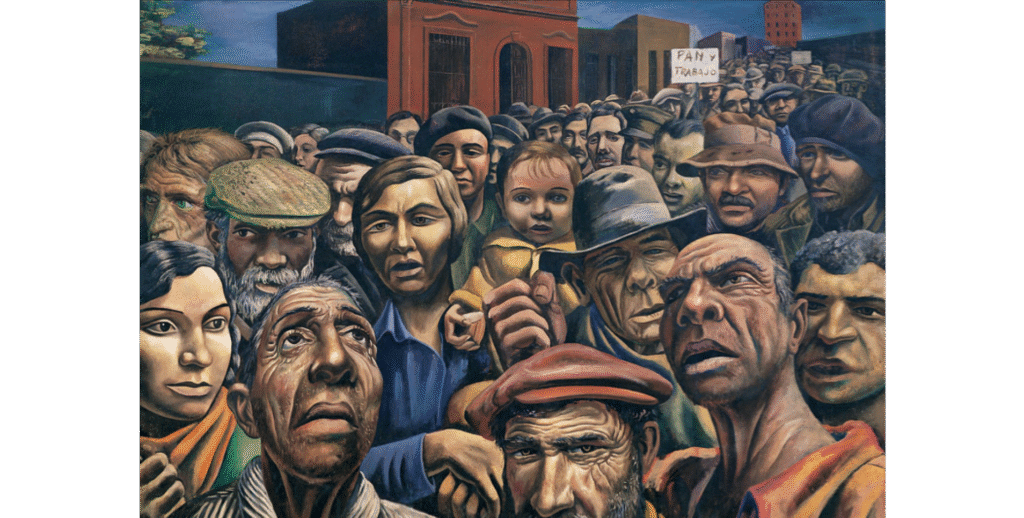
Navigating Argentina’s painting legacy invites collectors into a world where social critique, geometric rigor, surrealist wonder, and costumbrista charm coalesce. Each work—whether Berni’s politically charged friezes or Le Parc’s hypnotic illusions—carries its own narrative, style, and market trajectory. By understanding the techniques, historical contexts, and scarcity of these masterpieces, collectors can curate a portfolio that captures Argentina’s artistic diversity and secures enduring value.
Related Articles